Guide
The priority rules in surfing
One wave, one surfer. Who has priority, what a drop-in is, and how to paddle back to the peak without getting in anyone's way.
The golden rule
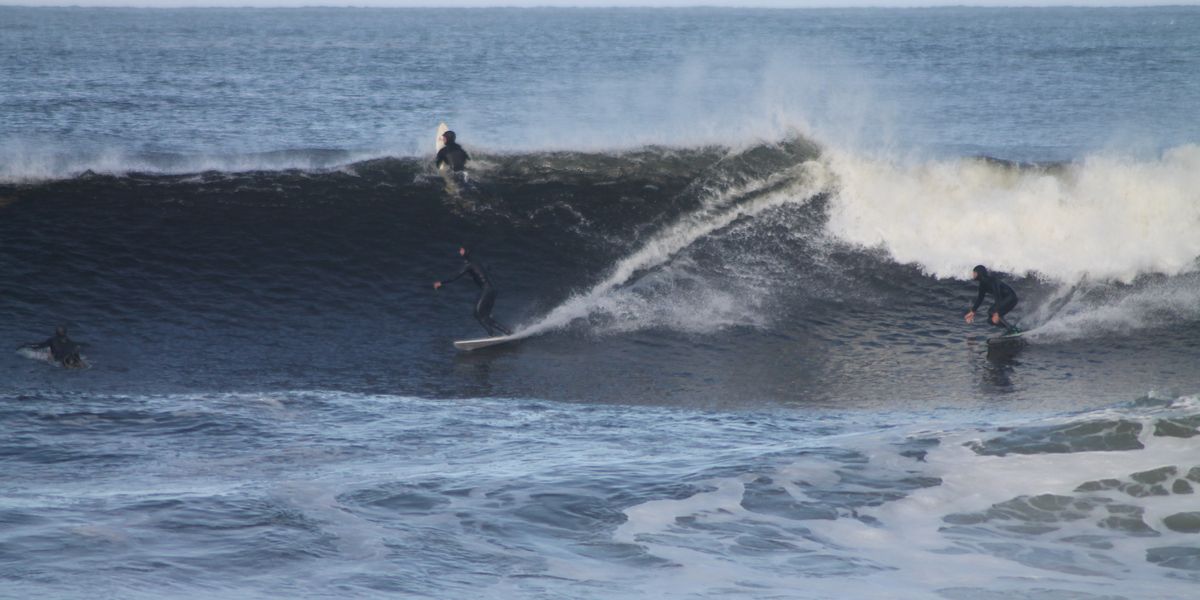
The surfer closest to the peak, where the wave starts to break, has priority. It lasts for the whole ride. One wave, one surfer. This is the rule of the French surfing federation.
Before you paddle for a wave, look toward the peak over your shoulder. If someone is deeper than you, pull back and let them go.
Two surfers on one wave
Some waves open both ways, like an A-frame. Two surfers can take the same wave if they go in opposite directions and do not get in each other's way. Shout your direction: left, or right.
If left and right are equally good at the start, the first surfer to make a move in a direction has it. The second can go the other way.
The drop-in
A drop-in is taking off on a wave that someone closer to the peak is already riding. It is the first rule broken in the water, and it is dangerous. The surfer at the take-off is at their most fragile, and cannot steer.
If you drop in by mistake, get off the wave as fast as you can, and apologise with a word or a hand.
Snaking
Snaking is paddling around other surfers to get closer to the peak and take their priority. It is jumping the queue. The surfer who took the wave from the deepest spot keeps priority, even if someone else takes off behind them in the whitewater.
The same goes for the next wave. Do not take every set wave. Let someone else go.
Paddling back out
A surfer on a wave has priority over a surfer paddling out. So paddle around the breaking zone. Use the channel if there is one: the current of a baïne is one. If you cannot, paddle toward the whitewater and leave the shoulder clear for the surfer who is riding.
If you are caught inside, aim for the whitewater too. Keep your board, and duck dive. A board and its leash make a danger zone around you.
At a spot you do not know
Do not go straight to the peak. Watch for ten minutes. See where people paddle out, and how they take turns. Some spots have a rotation of their own. Say hello. If it is crowded, walk down the beach.
The sources are the French surfing federation, Surfing Queensland and Surfing England. Know your line-up, and note who was out when you log a session: the crowd is part of the conditions.